B2B SaaS · AI
Shipped
·
2025
Role
Product Designer, UX/UI
Team
PM, Tech Lead, 3–4 engineers
Timeline
Sep–Nov 2025 · 6-week build
Company
Performance management platform
Signals
approval across 1,000+ leader ratings
leaders entering the Leadership module after launch
Competencies
AI & Intelligent Features
Complex B2B Workflows
Discovery & Research
Context
The company is a B2B SaaS performance management platform. Leadership engagement is one of the platform's core growth levers — leaders are the main multipliers of performance culture within companies. The goal with AI was to increase platform engagement, especially among leaders, by making the platform genuinely useful in their day-to-day management routines.
My role
I partnered with the PM on discovery (problem framing, interviews, usage analysis) and designed the feature end to end, from the first concepts through delivery and rollout. The solution direction came from the PM and me.
Problem
Leaders struggled to prepare and conduct performance management routines inside the platform. Even when data was registered, it was scattered across modules, poorly integrated, and never synthesized into actionable insights.
This forced leaders to export information manually, depend on admins for basic queries, and conduct management routines outside the platform entirely. The result: delayed diagnoses, lower decision quality, and a platform perceived as just a data repository — not a management tool.
Discovery
Methods: Continuous discovery (ongoing customer conversations, documented feedback) · Platform usage analysis · Stakeholder interviews · Pain point mapping
Volume: Feedback from our continuous customer conversations, across 3 leader segments: leaders who don't use the platform for management routines, leaders who use it partially, and leaders who conduct routines outside the platform entirely · Memorable quotes collected from clients across different segments and sizes
Key findings:
- Leaders constantly requested spreadsheet exports of PDI, 1:1, and other data because they couldn't draw conclusions from the platform alone
- When viewing team KRs, leaders wanted integrated context from 1:1s, feedback, and recognitions to apply the CFR methodology
- Leaders wanted better task tracking from 1:1s, categorized by relevance and progress to avoid losing commitments
- The platform wasn't delivering enough value for leaders to use it consistently without being required to by HR
What this told us:
The data existed — but it was invisible to the people who needed it most. Leaders weren't disengaged because they didn't care about performance management. They were disengaged because the platform made it harder, not easier, to do their job. The opportunity wasn't to add more data — it was to synthesize what already existed into something immediately useful.
How might we
How might we make the platform genuinely useful for leaders in their day-to-day management routines — reducing friction, surfacing relevant insights, and enabling action without requiring them to leave the platform?
Solution
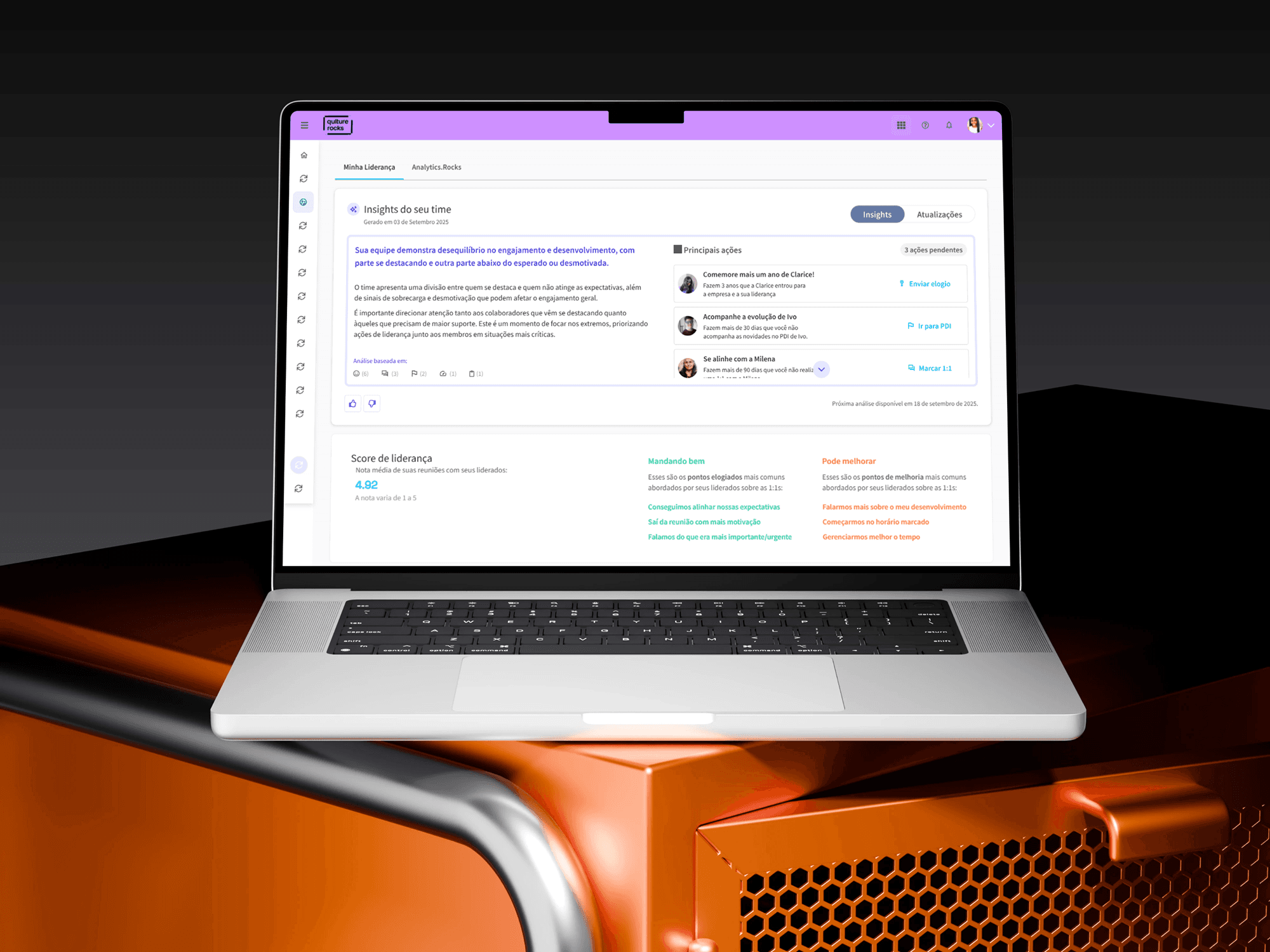
A proactive AI component that automatically generates team analysis and individualized action recommendations every two weeks — based on data already registered in the platform.
The Insight View surfaces a synthesized team analysis highlighting engagement patterns, performance imbalances, and team members who need attention. Alongside the analysis, the AI suggests specific, actionable next steps — each linked directly to the relevant platform action: sending recognition, reviewing a PDI, or scheduling a 1:1.
Analysis and recommendations are generated proactively and remain valid for two weeks, ensuring leaders always have a fresh starting point for their management routines — without having to search for information across modules.
Key decisions
Proactive, not on demand. A fresh analysis every two weeks, so leaders start from insight instead of a blank prompt.
Transparent sources. Each analysis shows its date and the data it used (1:1s, development plans, feedback, reviews), so leaders know what the AI saw.
Insight to action. Every recommendation links straight to the platform action: send recognition, review a development plan, schedule a 1:1.
Feedback loop. Thumbs up or down on each analysis to monitor quality.
Honest empty state. When there isn’t enough data, the screen says why and suggests actions that create it.
Admin control. Companies opt in to AI insights.
Biweekly email digest to bring leaders back, accepting a tested risk of overlap with an existing weekly email.

Results
What’s next
Leaders trust the analysis. The opportunity now is the gap between insight and action: recommendations aren’t converting into clicks at the rate we want. Next iteration: recommendation relevance, CTA copy and placement, and better instrumentation (a “viewed” event) to measure conversion accurately.
